

What is autoimmune Type 1 diabetes (T1D)?
Learn about T1D and what causes it
What is T1D?
Type 1 diabetes is a progressive autoimmune disease. This means that the body’s immune system mistakenly attacks healthy cells in the body. In the case of T1D, the immune system attacks a type of cell in the pancreas called beta cells. Healthy beta cells produce a hormone called insulin which helps your body convert glucose (sugar) from your blood into energy.1
When beta cells are damaged in T1D, they cannot produce enough insulin for your body. Without insulin, the body can’t move sugar from your blood into cells to use for energy, so your blood sugar becomes too high. Overtime, this results in the symptoms of T1D.1–3
Insulin is like a key that unlocks cells to let sugar in.2,4
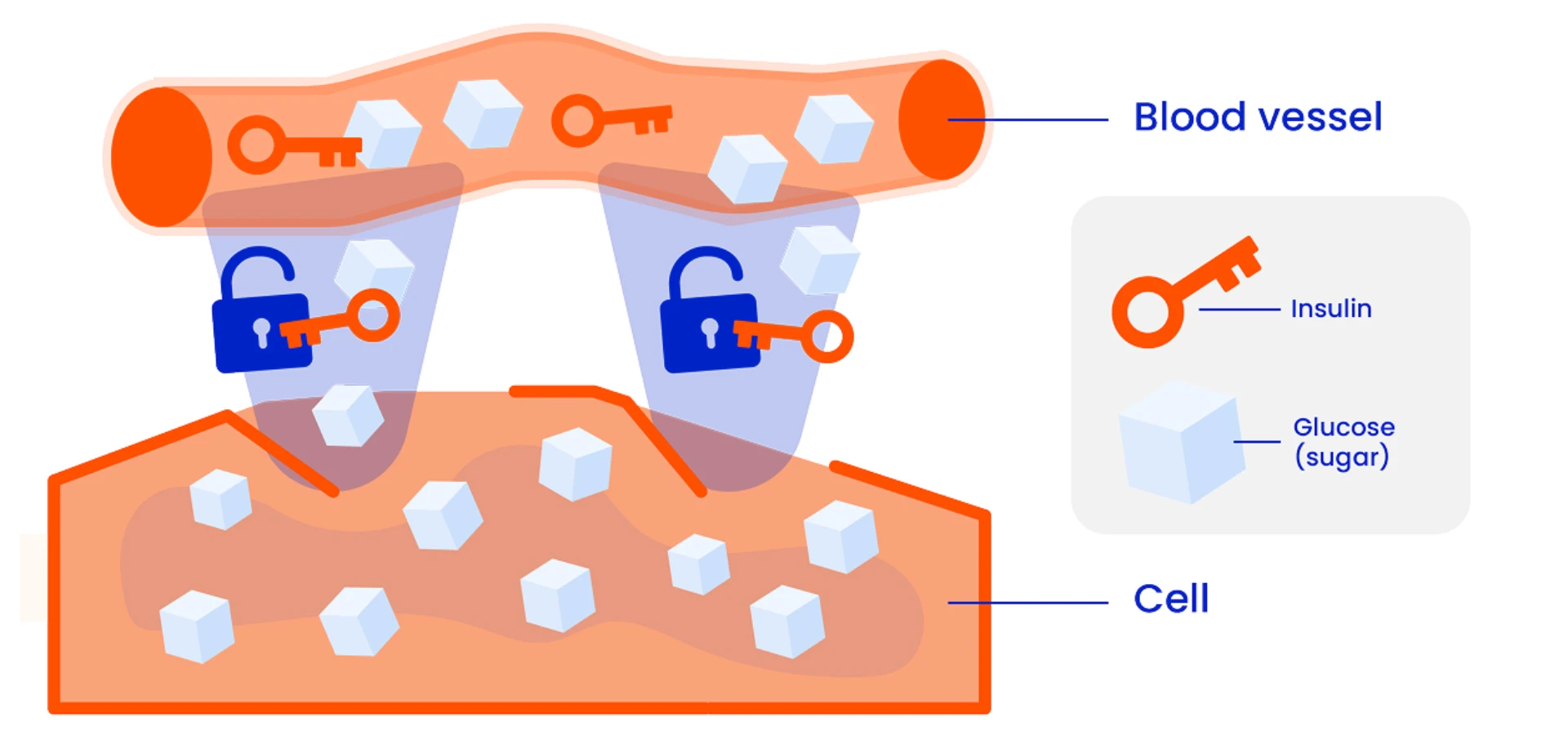
Adapted from Healthhub. How diabetes develops.4
What causes T1D?
We don’t know the exact cause of T1D, though there are some things that increase your risk of developing it.1

You may be at increased risk if you have a family member with T1D.1,3,5,6
If you have a first-degree relative (parent, sibling, or child) with T1D, your risk of developing it increases compared to people without family with T1D. However, many people with T1D don’t have any family with the condition.

T1D is not caused by what you eat or drink, but it’s still important to eat a healthy diet to help manage your blood sugar levels.1

You may be at an increased risk if you have other autoimmune diseases, such as:7–10
- Thyroid disease
- Coeliac disease
- Addison’s disease



Tzield is a medicine used to delay the start of Stage 3 Type 1 diabetes. This condition happens when the body cannot make enough insulin on its own and may need insulin injections. This medicine is used in adults and children aged 8 years and older who have Stage 2 Type 1 diabetes.11
If you have any questions on how Tzield works or about your treatment with Tzield, ask your doctor.
This website is not intended to be a substitute for medical advice. Please refer to the Patient information leaflet and the Patient Guide for full safety information. You may have received these items from your doctor already.
The contents of this website have been developed and funded by Sanofi.
References:
- Diabetes UK. What causes type 1 diabetes. Available at: https://www.diabetes.org.uk/about-diabetes/type-1-diabetes/causes. Accessed: September 2026.
- Diabetes UK. What is insulin? Available at: https://www.diabetes.org.uk/about-diabetes/looking-after-diabetes/treatments/insulin/what-is-insulin. Accessed: September 2026.
- Diabetes UK. Type 1 diabetes. Available at: https://www.diabetes.org.uk/about-diabetes/type-1-diabetes. Accessed: September 2026.
- Healthhub. How diabetes develops. Available at: https://www.healthhub.sg/programmes/diabetes-hub/how-diabetes-develops. Accessed: September 2026
- Breakthrough T1D. Who is at risk for type 1 diabetes? Available at: https://www.breakthrought1d.org/news-and-updates/who-is-at-risk-for-type-1-diabetes/. Accessed: September 2026.
- Besser REJ, Bell KJ, Couper JJ, et al. ISPAD Clinical Practice Consensus Guidelines 2022: Stages of type 1 diabetes in children and adolescents. Pediatr Diabetes. 2022; 23(8): 1175–1187.
- Barker JM. Clinical review: Type 1 diabetes-associated autoimmunity: natural history, genetic associations, and screening. J Clin Endocrinol Metab. 2006; 91(4): 1210–1217.
- Ludvigsson JF, Ludvigsson J, Ekbom A, et al. Celiac disease and risk of subsequent type 1 diabetes: a general population cohort study of children and adolescents. Diabetes Care. 2006; 29(11): 2483–2488.
- Skov J, Kuja-Halkola R, Magnusson PKE, et al. Shared etiology of type 1 diabetes and Hashimoto's thyroiditis: a population-based twin study. Eur J Endocrinol. 2022; 186(6): 677–685.
- Edelman SV, Agardh D, Cui N, et al. Risk of new-onset type 1 diabetes in individuals with celiac disease and thyroid disease-An observational study. Diabetes Obes Metab. 2025; 27(8): 4229–4238.
- TZIELD® (teplizumab) UK Patient Information Leaflet.
Reporting side effects
If you get any side effects, talk to your doctor, pharmacist or nurse. This includes any possible side effects not listed in the package leaflet. You can also report side effects directly via the Yellow Card Scheme at www.mhra.gov.uk/yellowcard or search for MHRA Yellow Card in the Google Play or Apple app Store.
Alternatively, you can report side effects to Sanofi on Tel: 0800 0902 314 or send via email to UK-drugsafety@sanofi.com. By reporting side effects, you can help provide more information on the safety of this medicine.
▼This medicine is subject to additional monitoring. This will allow quick identification of new safety information. You can help by reporting any side effects that you may get. See www.mhra.gov.uk/yellowcard for how to report side effects.
© 2026 Sanofi. All rights reserved. MAT-XU-2501104 (V2.0) | September 2026
Welcome to Tzield

Welcome to Tzield
This website and its contents have been developed by Sanofi for patients in the United Kingdom who have been prescribed Tzield.
In order to proceed into the website, please confirm that you are, or you care for, a patient in the United Kingdom prescribed Tzield by clicking the confirmation button below.
MAT-XU-2503330 (V2.0) - Date of preparation: September 2026